


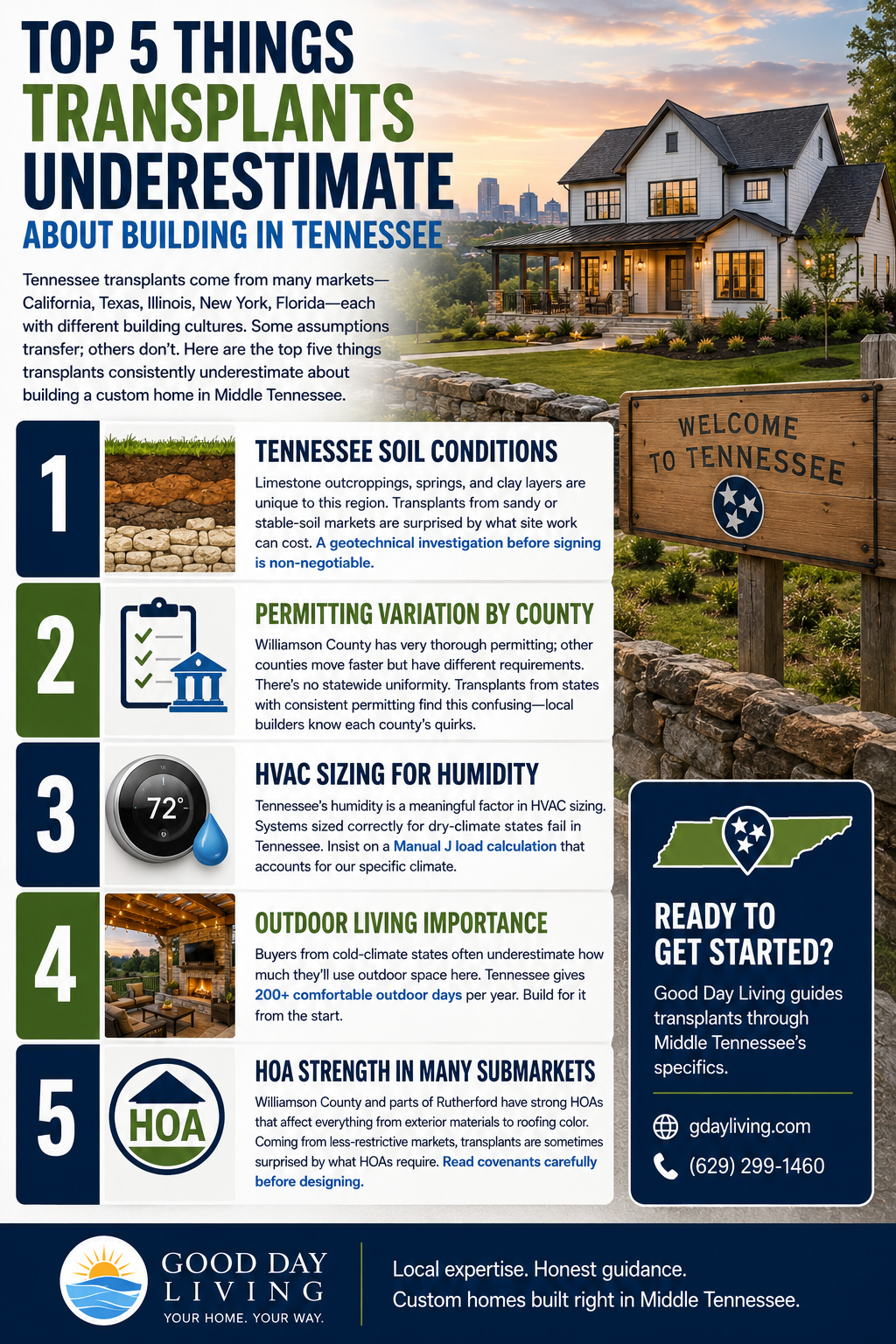
Tennessee transplants come from many markets — California, Texas, Illinois, New York, Florida — each with different building cultures. Some assumptions transfer; others don’t. Here are the top five things transplants consistently underestimate about building a custom home in Middle Tennessee.
#1: Tennessee Soil Conditions
Limestone outcroppings, springs, and clay layers are unique to this region. Transplants from sandy or stable-soil markets are surprised by what site work can cost. A geotechnical investigation before signing is non-negotiable.
#2: Permitting Variation by County
Williamson County has very thorough permitting; other counties move faster but have different requirements. There’s no statewide uniformity. Transplants from states with consistent permitting find this confusing — local builders know each county’s quirks.
#3: HVAC Sizing for Humidity
Tennessee’s humidity is a meaningful factor in HVAC sizing. Systems sized correctly for dry-climate states fail in Tennessee. Insist on a Manual J load calculation that accounts for our specific climate.
#4: Outdoor Living Importance
Buyers from cold-climate states often underestimate how much they’ll use outdoor space here. Tennessee gives 200+ comfortable outdoor days per year. Build for it from the start.
#5: HOA Strength in Many Submarkets
Williamson County and parts of Rutherford have strong HOAs that affect everything from exterior materials to roofing color. Coming from less-restrictive markets, transplants are sometimes surprised by what HOAs require. Read covenants carefully before designing.
Ready to Get Started?
Good Day Living guides transplants through Middle Tennessee’s specifics. Reach out at gdayliving.com or (629) 299-1460.