


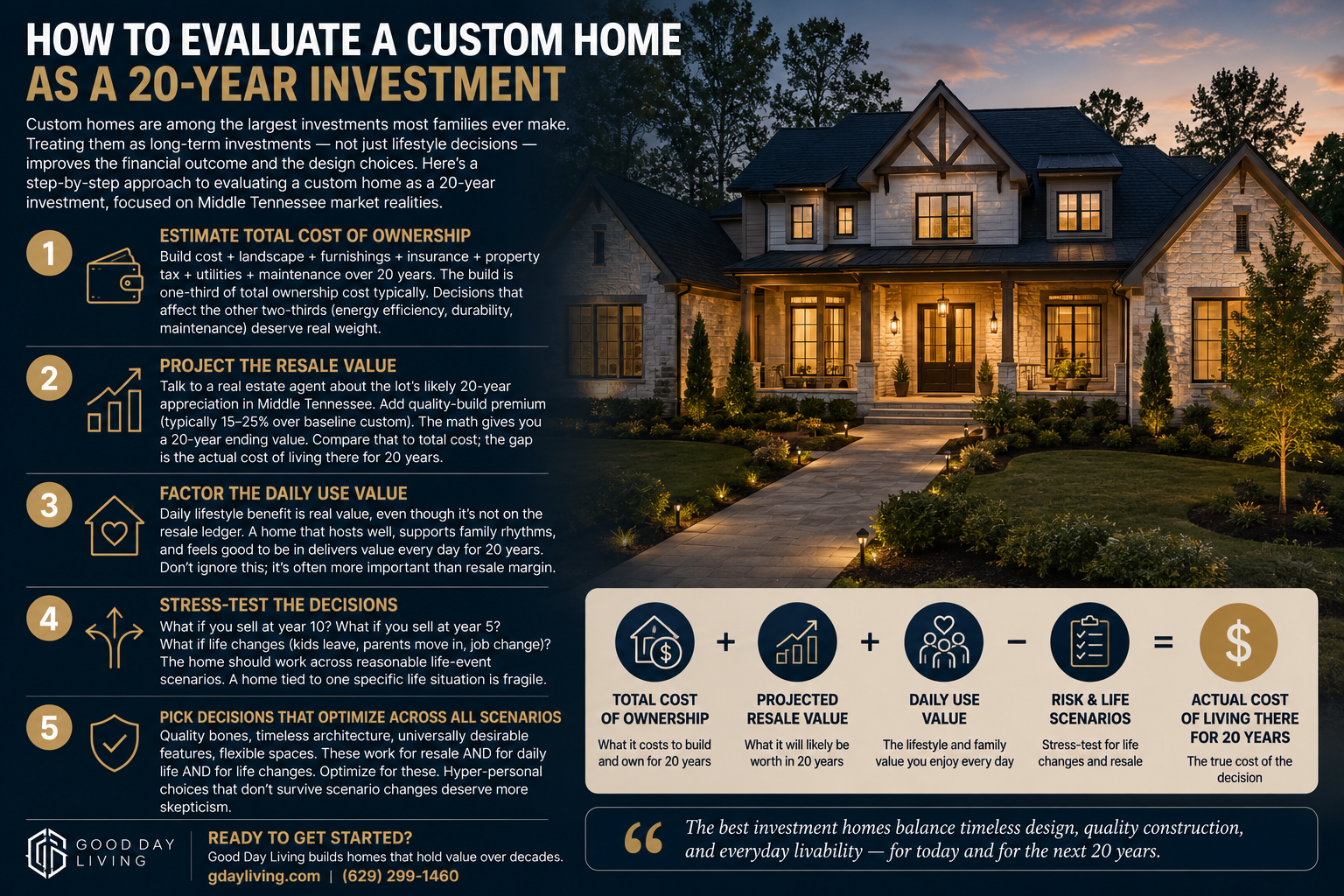
Custom homes are among the largest investments most families ever make. Treating them as long-term investments — not just lifestyle decisions — improves the financial outcome and the design choices. Here’s a step-by-step approach to evaluating a custom home as a 20-year investment, focused on Middle Tennessee market realities.
Step 1: Estimate Total Cost of Ownership
Build cost + landscape + furnishings + insurance + property tax + utilities + maintenance over 20 years. The build is one-third of total ownership cost typically. Decisions that affect the other two-thirds (energy efficiency, durability, maintenance) deserve real weight.
Step 2: Project the Resale Value
Talk to a real estate agent about the lot’s likely 20-year appreciation in Middle Tennessee. Add quality-build premium (typically 15-25% over baseline custom). The math gives you a 20-year ending value. Compare that to total cost; the gap is the actual cost of living there for 20 years.
Step 3: Factor the Daily Use Value
Daily lifestyle benefit is real value, even though it’s not on the resale ledger. A home that hosts well, supports family rhythms, and feels good to be in delivers value every day for 20 years. Don’t ignore this; it’s often more important than resale margin.
Step 4: Stress-Test the Decisions
What if you sell at year 10? What if you sell at year 5? What if life changes (kids leave, parents move in, job change)? The home should work across reasonable life-event scenarios. A home tied to one specific life situation is fragile.
Step 5: Pick Decisions That Optimize Across All Scenarios
Quality bones, timeless architecture, universally desirable features, flexible spaces. These work for resale AND for daily life AND for life changes. Optimize for these. Hyper-personal choices that don’t survive scenario changes deserve more skepticism.
Ready to Get Started?
Good Day Living builds homes that hold value over decades. gdayliving.com or (629) 299-1460.